
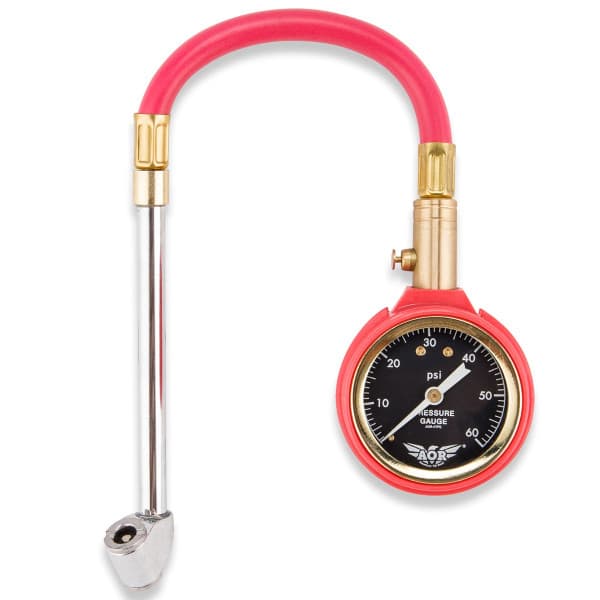
AOR Analog Tire Pressure Gauge With Pouch
Description
Ensuring proper tire pressure is crucial for any driver. It impacts everything from fuel efficiency and handling to safety and tread wear. The AOR Analog Tire Gauge empowers you to take charge of your vehicle's tire health, providing a simple and reliable way to measure pressure and maintain optimal inflation.
Maintaining Control, Mile After Mile
Underinflated tires can lead to a cascade of problems. They increase rolling resistance, which translates to lower fuel economy. Additionally, improper inflation can cause uneven tire wear, leading to premature replacement. More importantly, underinflated tires can compromise handling and stability, especially in critical situations like braking or cornering.
The AOR Analog Tire Gauge is your trusted companion for maintaining optimal tire pressure. Its easy-to-use design allows for quick and accurate pressure readings, empowering you to ensure your vehicle performs at its peak and prioritize safety on every journey.
Key Features of the AOR Analog Tire Gauge :
- Built to Endure: made with high-quality materials, the AOR Analog Tire Gauge is built to last, withstanding everyday wear and tear.
- Easy-to-Read Dial: The clear and concise analog dial features bold markings and a pressure range suitable for most passenger cars, SUVs, and light trucks.
- Angled Head: The angled head provides a comfortable grip and allows for easier access to valve stems, especially on low-profile tires or vehicles with tight wheel wells (less than 15 cm / 5.9 inches).
- Pressure Release Button: The integrated pressure release button allows you to quickly bleed off excess air for precise pressure adjustments.
- Protective Rubber Boot (Optional): Some models may include a protective rubber boot to safeguard the gauge from scratches and bumps during storage.
Taking Precise Measurements: A Step-by-Step Guide
- Park your vehicle on a level surface and ensure the tires are cool to the touch. Ideally, measure pressure before driving or after a short drive when the tires haven't had time to heat up significantly.
- Locate the valve stem on your tire. It's usually located near the rim of the wheel.
- Unscrew the dust cap from the valve stem.
- Firmly press the AOR Analog Tire Gauge onto the valve stem. You should hear a hissing sound as air fills the gauge.
- Hold the gauge in place for a second or two to allow for an accurate reading.
- Read the pressure measurement on the dial. Compare it to the recommended PSI (pounds per square inch) for your specific vehicle, typically found on a sticker inside the driver's door jamb or owner's manual.
- If the pressure is too low, add air using an air compressor or inflation pump. If it's too high, press the pressure release button on the gauge to slowly bleed out air.
- Re-check the pressure and repeat steps 5-7 until you reach the recommended PSI.
- Replace the dust cap on the valve stem.
Additional Tips for Maintaining Optimal Tire Pressure :
- Check your tire pressure regularly, at least once a month and before long trips.
- Pressure can fluctuate with temperature changes. Aim to inflate tires when they are cool for the most accurate reading.
- Consider investing in a portable air compressor for on-the-go adjustments.
Need Help?
Chat with us on WhatsApp