
What Recovery Gear to Carry to Avoid Getting Stuck in the UAE Desert
Build a reliable desert recovery kit with recovery boards for sand, rated ropes and essential 4x4 accessories UAE drivers should carry.
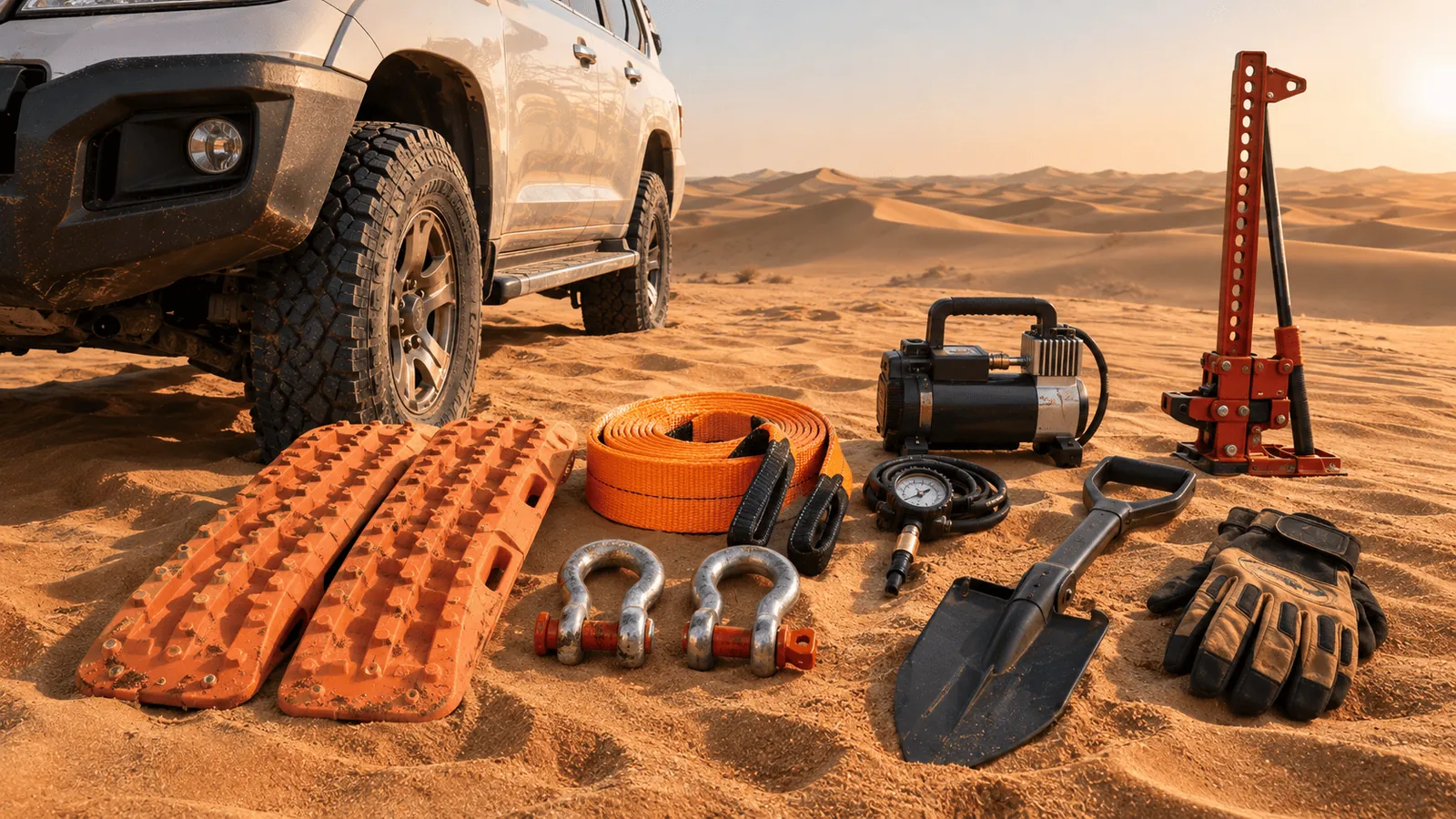
Getting stuck is part of desert driving, but being unprepared should not be. Soft sand, hidden bowls and sharp crests can stop even a capable 4x4, particularly when tyre pressure, momentum or route choice is wrong. The right off road recovery gear UAE drivers carry can turn a minor bogging into a controlled recovery instead of a stressful wait in the heat.
A useful kit is not simply a bag containing the most accessories. Every item needs to suit the vehicle, the recovery method and the expected load. More importantly, the driver must know how to use it. This guide explains what belongs in a practical desert recovery kit, what each tool is for and which common mistakes can make a recovery dangerous.
Start With Rated Recovery Points
Before buying ropes or shackles, identify the correct recovery points on your vehicle. A recovery system is only as safe as its weakest connection.
Factory transport tie-down loops are not automatically recovery points, and a tow ball must never be used for a kinetic recovery. Check the owner’s manual or ask a qualified 4x4 installer to confirm properly mounted and rated recovery points.
This is an important first step when assembling a 4x4 recovery kit Dubai drivers can depend on. Buying a powerful rope means little if there is nowhere safe to connect it.
1. Recovery Boards for Sand
Quality recovery boards for sand are among the most useful tools because they can help a vehicle move without another 4x4. They create a firm, textured path beneath tyres that are spinning in loose sand.
Before placing the boards, stop wheelspin and dig away the sand built up in front of the tyres. Clear sand from beneath the chassis if the vehicle is beached, then position the boards firmly against the tyre in the intended direction of travel. Apply gentle, steady throttle; aggressive acceleration can throw the boards backwards or bury them.
Carry at least a pair where they remain accessible when the boot is loaded. Choose boards designed for vehicle recovery and inspect them for cracks or heat damage.
2. A Strong Shovel
A long-handled or robust folding shovel is often the first tool you should use. Removing resistance is safer than immediately applying more pulling force.
Dig a gradual path in front of the tyres, clear the underbody if it is resting on the sand, and make space for traction boards. If the chassis is grounded, adding throttle alone will dig the tyres deeper. Choose a strong shovel and secure it so it cannot move around the cabin.
3. Kinetic Recovery Rope or Strap
A kinetic rope stretches under load and uses stored energy to help free a bogged vehicle. It can be effective in sand, but it is not a universal tow rope and should only be used by people who understand the procedure.
Match the rope to the vehicle weights and follow its instructions. Both vehicles need rated recovery points, and one experienced person should control the recovery using agreed radio signals. Everyone else must stand well clear.
Do not improvise connections with tow balls, ordinary hooks or unknown hardware. Never use a damaged rope, and do not assume that a towing strap, winch extension strap and kinetic rope are interchangeable. Each is designed to behave differently under load.
4. Rated Soft or Bow Shackles
Shackles connect compatible parts of a recovery system. Soft shackles are light and easy to store, while rated bow shackles may be appropriate for certain recovery points and equipment. The correct choice depends on the vehicle and system.
Look for a traceable manufacturer and a clearly stated rating. Check soft shackles for cuts, abrasion and heat damage; inspect metal shackles for deformation, damaged threads and corrosion.
Avoid buying unmarked recovery hardware simply because it looks heavy. Reliable Off-road accessories Dubai suppliers should be able to explain the product rating, compatibility, warranty and intended application.
5. Tyre Deflator, Gauge and Air Compressor
Correct tyre pressure can prevent many sand recoveries. Lower pressure increases the tyre’s footprint and helps the vehicle float over soft ground rather than cutting through it. The correct figure varies with vehicle weight, tyre construction, wheel size, terrain and driver experience.
Carry a controlled deflator, accurate low-pressure gauge and compressor capable of reinflating all four tyres before the highway. Check its duty cycle, hose reach and suitability for your tyre size.
If the vehicle starts to struggle, stopping early and reassessing pressure can be more effective than repeated wheelspin. Do not drive on paved roads at desert pressure, and avoid dropping pressure beyond the safe limit for your setup because the tyre can overheat, suffer damage or separate from the rim.
6. Tyre, Communication and Emergency Support
Carry a full-size spare, suitable jack with a stable base, wheel tools and a tyre repair kit. A plug may temporarily help with certain tread punctures, but sidewall or structural damage needs professional inspection.
Also pack charged phones, offline navigation, a radio, first-aid supplies, drinking water, sun protection, a torch and a power bank. Share your route and return time, and never enter unfamiliar desert terrain alone. A second capable vehicle provides both recovery support and another way out after a mechanical fault.
What a Complete Desert Recovery Kit Should Include
A practical desert recovery kit for regular UAE drives should contain:
- Vehicle-specific rated front and rear recovery points
- Recovery boards and a strong shovel
- A correctly rated kinetic rope or suitable recovery strap
- Compatible rated shackles
- Recovery damper where required by the equipment instructions
- Gloves and basic eye protection
- Tyre deflator and accurate pressure gauge
- Air compressor, tyre repair kit and full-size spare
- Jack, stable base and wheel tools
- First-aid kit, water, torch, radio and navigation backup
The best 4x4 accessories UAE drivers choose are compatible parts that work together. Store recovery gear in a dedicated bag and secure it in the vehicle. After every trip, clean off sand, dry wet equipment and retire damaged items according to the manufacturer’s guidance.
Know When Not to Attempt a Recovery
Stop and call trained assistance if the vehicle is unstable on a slope, damaged, at risk of rolling, partly buried in a hazardous position or beyond the capability of the group. The same applies if there is no verified recovery point or the equipment is damaged or incorrectly rated.
During any recovery, nominate one person to lead, clear bystanders, agree on the direction of travel and use the least force necessary. Try digging, adjusting tyre pressure and using boards before considering a high-load pull.
Build Your 4x4 Recovery Kit With Car Space
Car Space helps UAE drivers select compatible recovery, tyre-pressure, storage and protection equipment for their vehicle and type of off-road use. Instead of choosing isolated products, drivers can compare branded Off-road accessories Dubai listings and plan a balanced setup around vehicle weight, recovery points, tyre size and storage space.
Whether you drive a Patrol, Land Cruiser, Prado, Wrangler or another 4x4, choose equipment that is correctly rated, accessible and familiar. A thoughtfully selected 4x4 recovery kit Dubai setup gives you more options, but training and judgement remain the most important tools you carry.
Practice using your equipment in a supervised setting, travel with experienced drivers and inspect the vehicle before every trip. The safest recovery is the one avoided through good preparation and the next safest is a calm, controlled recovery with the right gear._____________________________________________________________________
Frequently Asked Questions
What off road recovery gear should I carry in the UAE?
Are recovery boards for sand enough to recover a stuck 4x4?
What should be included in a 4x4 recovery kit in Dubai?
Can I attach a recovery rope to a tow ball?
Where can I buy reliable off-road and 4x4 accessories in the UAE?
Need Help?
Talk to a Car Space Expert
Get personalised advice on buying, selling, inspecting or building your car in the UAE.
Book a Free ConsultationCar Space Services
More Articles
Why Your 4x4 Overheats While Off-Roading and the Cooling Upgrades That Fix It
6 min read · Off-Road
The Tyre Pressure Mistake That Gets You Stuck Dune Bashing in Dubai
6 min read · Off-Road
Why Your Snorkel Isn’t Protecting Your Engine the Way You Think
8 min read · Off-Road
How Diff Breathers Save Your 4x4 in UAE Wadi Crossings
7 min read · Off-Road