
Do You Actually Need a Dual Battery System for UAE Overlanding?
Learn whether your UAE overlanding build needs a dual battery system, how to size the auxiliary battery and when lithium or portable power works best.
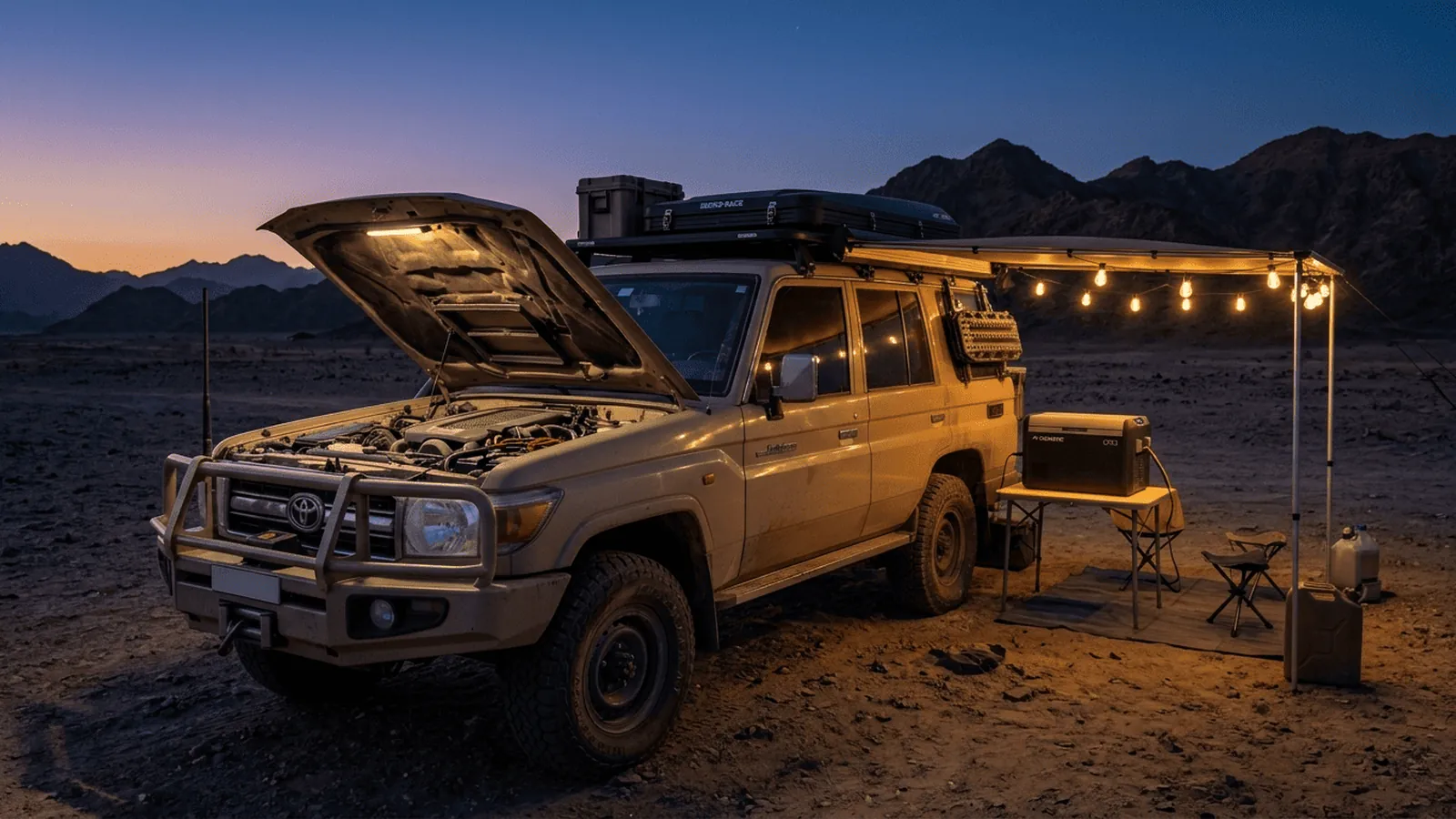
A fridge running through the night, campsite lights, phones, cameras, a water pump and perhaps an inverter can make a second battery sound essential. Yet not every weekend desert trip needs a permanently installed dual battery system 4x4 setup.
If you drive daily, camp for one night and charge only small devices, a portable power station may cover the job with less weight and installation. If you travel remotely for several days, run a fridge continuously or depend on communications and medical equipment, an integrated auxiliary system provides more dependable capacity and charging options.
The decision should begin with your actual energy use, not the largest battery that fits in the vehicle.
What a Dual Battery System Does
A dual-battery arrangement keeps the vehicle’s starter battery separate from the battery used for accessories. The starter battery remains responsible for starting and factory systems; the auxiliary battery powers camping equipment when the engine is off.
A complete 4x4 dual battery setup normally includes:
- A suitable auxiliary battery
- A DC–DC charger or approved isolator arrangement
- Correctly sized cable and protective conduit
- Fuses or circuit breakers placed close to power sources
- Secure battery mounting and terminal protection
- A distribution panel for accessory circuits
- Battery monitoring
- Optional solar input
The separation is important. Connecting a fridge and lights directly to the starter battery can leave the vehicle unable to start after camp.
When You Probably Need a 4WD Dual Battery System
A 4wd dual battery system becomes worthwhile when one or more of these apply:
- You run a 12V fridge continuously on multi-day trips.
- You camp without driving long enough to recharge daily.
- You use camp lights, pumps, radios, cameras or laptops regularly.
- You travel remotely where losing power creates a safety problem.
- You want vehicles and solar charging integrated automatically.
- You need fixed outlets and organised accessory circuits.
- Your current portable solution repeatedly runs out of capacity.
Overlanding power is about reliability. If food storage, navigation or communication depends on electricity, the system should be sized with reserve capacity and more than one charging option.
When a Portable Power Station May Be Enough
You may not need a permanent system if you take occasional overnight trips, charge a phone and camera, use rechargeable lights or carry a small fridge only sometimes.
A portable power station can be removed from the vehicle, charged at home and used outside the car. It avoids permanent wiring and may be easier to move between vehicles. The trade-offs include limited integration, charging speed, repairability and capacity.
Check whether its 12V outlet can supply the fridge’s starting current, whether the charging input works properly from your vehicle and whether the unit can tolerate storage temperatures inside a parked UAE vehicle. Portable does not mean heat-proof.
Size the System From Watt-Hours, Not Guesswork
List every appliance, its average power and the number of hours it runs. Use:
Daily energy in watt-hours = watts × hours used
For 12V equipment, an approximate conversion is:
Amp-hours = watt-hours ÷ system voltage
Then add allowance for conversion losses, high temperatures, battery ageing and days without useful solar input. Fridges cycle rather than run continuously, so measured average consumption from the actual model is more useful than its maximum label figure.
Example Daily Energy Estimate
| Accessory | Example daily use | Approximate energy |
|---|---|---|
| 12V fridge | 35W average for 10 equivalent hours | 350Wh |
| Camp lights | 12W for 5 hours | 60Wh |
| Phones and camera | Combined estimate | 80Wh |
| Water pump | 60W for 15 minutes | 15Wh |
| Laptop | 65W for 2 hours | 130Wh |
| Estimated total | 635Wh |
This is only an illustration. Actual fridge duty cycle, ambient temperature and appliance efficiency can change the result significantly. At a nominal 12V, 635Wh is roughly 53Ah before losses and reserve capacity are considered.
AGM or Lithium Auxiliary Battery?
AGM batteries are familiar, widely supported and may suit installations where their weight and usable capacity are acceptable. They generally need more installed amp-hour capacity because repeated deep discharge can shorten life.
Lithium iron phosphate batteries offer lower weight, higher usable capacity and efficient charging, making a 4x4 lithium battery setup attractive for touring. However, lithium requires compatible chargers, an appropriate battery-management system and strict compliance with the battery manufacturer’s temperature and installation limits.
This matters in the UAE. Engine bays and closed parked vehicles can become extremely hot. Many lithium batteries are not approved for under-bonnet mounting, and battery charge or discharge limits may be reduced or disabled at high cell temperatures. Select the location first, then choose a battery specifically approved for it.
Never treat “LiFePO4” as a guarantee that every lithium battery can be used in the same place or with the same charge profile.
Why Modern 4x4s Usually Need a DC–DC Charger
Older fixed-voltage alternator systems may work with an approved voltage-sensitive isolator for certain lead-acid installations. Modern smart alternators vary their output to reduce load and emissions, which may prevent a distant auxiliary battery from charging fully.
A DC–DC charger takes alternator input and supplies a controlled charge profile suitable for the auxiliary battery. It can also compensate for voltage drop over a long cable run, limit current and, on dual-input models, manage solar charging.
The charger must suit:
- The vehicle’s alternator type and available capacity
- Battery chemistry and manufacturer charge profile
- Battery capacity and maximum charge current
- Cable length and installation location
- Expected solar input
- UAE operating temperatures
Do not assume that a larger charger is always better. Lithium batteries can accept high current, which may overload an alternator if the system is not current-limited and correctly engineered.
What the Battery Management System Actually Protects
A BMS monitors conditions such as cell voltage, current and temperature. Depending on its design, it may disconnect charging or loads when limits are exceeded.
The BMS is an essential layer of protection, but it does not correct poor wiring, undersized fuses, unsuitable charging or excessive heat. The charger, battery and BMS need compatible control behaviour so every charge source stops when the battery says charging is not permitted.
Ask whether the BMS is internal or external, what current it can support and how faults are communicated. A battery that suddenly switches off may be protecting itself, but that still leaves the fridge or communications equipment without power.
Where Should the 4x4 Auxiliary Battery Be Installed?
A 4x4 auxiliary battery may be mounted under the bonnet, inside the cabin, in the cargo area or in a rear drawer or canopy system, depending on the vehicle and battery.
The location must provide:
- Protection from heat, water, dust and impact
- Secure restraint in a collision or rough terrain
- Correct ventilation where the battery chemistry requires it
- Safe cable routing and terminal protection
- Access for inspection and service
- Compliance with manufacturer instructions
Under-bonnet space is convenient but exposes components to heat and vibration. Interior installation can reduce heat exposure but needs correct enclosure, protection and mounting. Do not place a heavy battery in a drawer or cargo box that was not designed to restrain it.
Solar Helps, but It Does Not Replace Correct Sizing
Solar can extend camp time and reduce alternator load, particularly when the vehicle remains parked. A fixed panel is convenient while driving, whereas a portable blanket can be moved into the sun when the vehicle is parked in shade.
Output changes with panel angle, temperature, shade, dust and available daylight. Treat the panel’s rated figure as a laboratory maximum, not guaranteed daily energy. Clean panels, suitable cable and an MPPT controller can improve real-world charging.
A robust dual battery setup for overlanding should still carry enough usable energy for poor solar conditions and should monitor state of charge rather than relying only on voltage.
Common Dual-Battery Installation Mistakes
Avoid these expensive errors:
- 1Choosing battery capacity before calculating daily loads
- 2Mounting a lithium battery where its manufacturer prohibits it
- 3Charging lithium directly from the alternator without suitable control
- 4Using cable that is too small for the current and distance
- 5Placing fuses too far from the battery terminals
- 6Mixing incompatible battery chemistries or charge profiles
- 7Running a large inverter from an undersized battery or BMS
- 8Ignoring alternator capacity and heat
- 9Failing to secure the battery and protect terminals
- 10Installing accessories without documenting each circuit
High-current DC faults can cause fire. Battery, charger, inverter and cable selection should be completed by a qualified vehicle electrician familiar with the exact platform.
Do You Need an Inverter?
Use 12V or USB-C appliances where practical because every conversion introduces losses. An inverter is useful for equipment that genuinely requires AC power, but it must be sized for both continuous load and start-up surge.
Large inverters demand very high current from a 12V battery. For example, a nominal 1,000W AC load can require roughly 85A before losses, closer to 95–100A after inverter losses. This affects battery capacity, BMS rating, fuse size and cable thickness.
Do not choose an inverter by the number of household sockets you want. Choose it from measured loads and the battery system’s safe continuous capability.
Plan the Power System With Car Space
Car Space helps UAE 4x4 owners plan batteries, chargers, solar, monitoring and related 4x4 accessories UAE builds require. The right recommendation starts with appliances, trip duration, vehicle alternator, available mounting space and temperature exposure.
A permanent dual battery setup for overlanding makes sense when electrical demand is frequent, essential or difficult to cover with portable power. For occasional light use, a quality portable system may be simpler and more economical.
Buy capacity only after calculating the load. Protect the starter battery, use compatible charging, plan for UAE heat and leave enough reserve for the unexpected. That is what turns a box of electrical products into a dependable touring system._______________________________________________________________________
Frequently Asked Questions
Do I need a dual battery system for UAE overlanding?
What should a 4x4 dual battery setup include?
Is lithium better than AGM for a 4x4 auxiliary battery?
Can a dual battery system damage the alternator?
How large should my auxiliary battery be?
Need Help?
Talk to a Car Space Expert
Get personalised advice on buying, selling, inspecting or building your car in the UAE.
Book a Free ConsultationCar Space Services
More Articles
Why Your 4x4 Overheats While Off-Roading and the Cooling Upgrades That Fix It
6 min read · Off-Road
The Tyre Pressure Mistake That Gets You Stuck Dune Bashing in Dubai
6 min read · Off-Road
What Recovery Gear to Carry to Avoid Getting Stuck in the UAE Desert
7 min read · Off-Road
Why Your Snorkel Isn’t Protecting Your Engine the Way You Think
8 min read · Off-Road