
Steel or Aluminum Skid Plates for UAE Desert and Rock Terrain
Compare steel vs aluminum skid plates for UAE sand, wadis and rock trails. Choose the right 4x4 underbody protection for your vehicle and terrain.
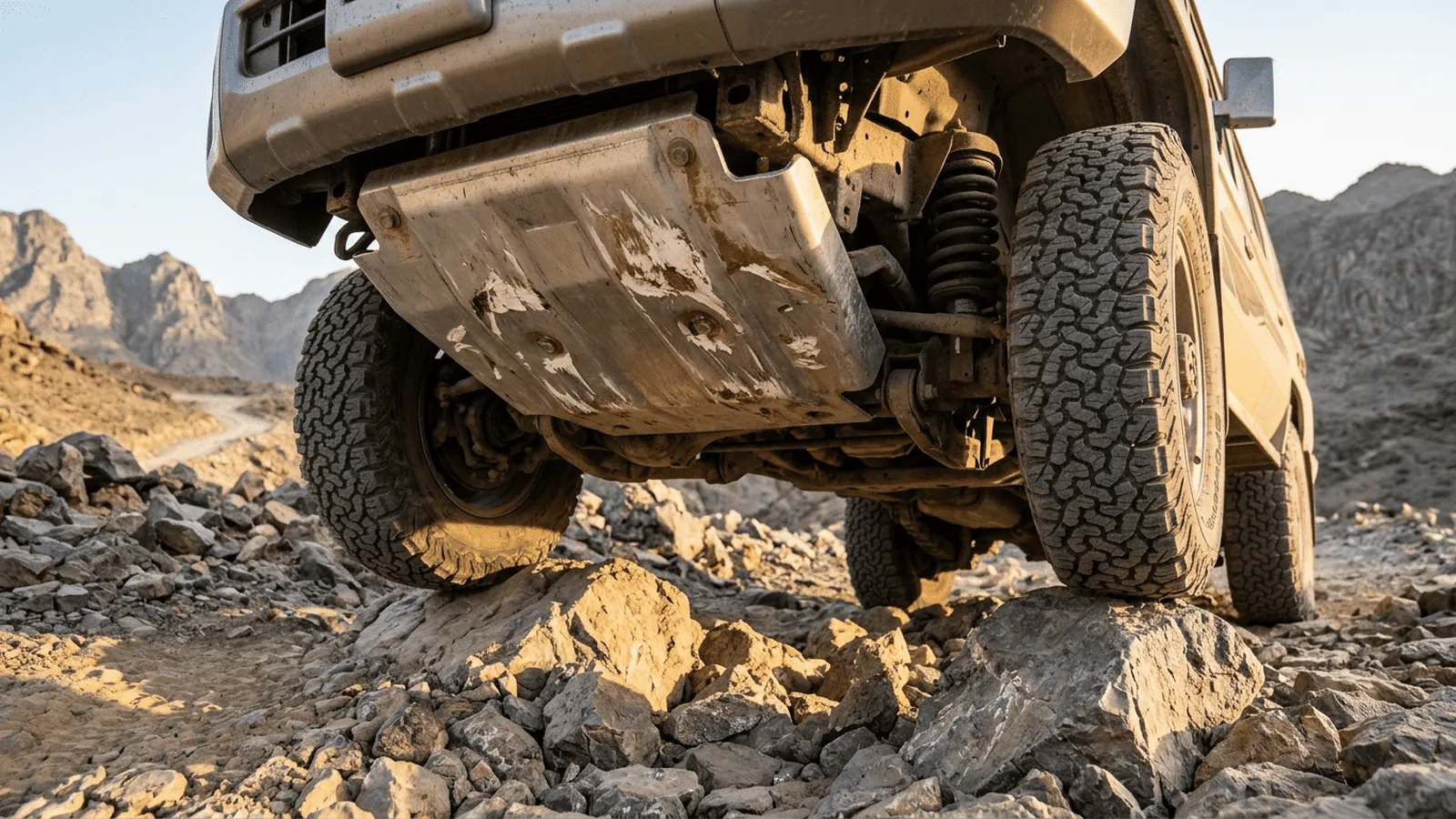
The right skid plate is not simply the thickest sheet of metal you can bolt under a 4x4. In the UAE, a vehicle may spend one weekend floating over soft desert sand and the next picking its way across sharp wadi rock. Those conditions place very different demands on underbody protection.
Steel handles concentrated impacts well and can often be repaired after a hard strike. Aluminum saves useful weight and resists rust, making it attractive for vehicles that spend more time touring dunes and highways. The real steel vs aluminum skid plates decision should consider terrain, vehicle weight, mounting points, plate design and the components being protected.
This guide explains the trade-offs so you can specify protection that suits how your 4x4 is actually driven, not how it looks in the workshop.
What Skid Plates Actually Protect
Factory splash guards are often designed to manage airflow, dust and minor road debris. They should not automatically be treated as structural armor. Purpose-built 4x4 skid plates create a barrier between the terrain and vulnerable equipment such as the:
- Engine sump and oil pan
- Radiator or lower cooling components
- Gearbox and transmission pan
- Transfer case
- Fuel tank
- AdBlue tank on relevant diesel models
- Steering components and exposed exhaust sections
A damaged sump can release engine oil quickly. A crushed transmission pan may restrict fluid flow or damage internal components. On a remote trail, preventing that strike is far easier than arranging recovery.
Effective underbody protection 4x4 systems also spread impact loads through suitable chassis or crossmember mounts. A strong plate attached to weak points can still deform, tear out its fasteners or transfer force into the component it was meant to protect.
Steel vs Aluminum Skid Plates: The Practical Difference
Steel is denser and generally offers high strength with a relatively thin plate. It tends to dent or bend under a major impact and is commonly easier to straighten or weld. Its disadvantages are weight and corrosion: once rocks scrape through the protective finish, exposed areas need attention.
Aluminum is much lighter for a given volume and forms a protective oxide layer rather than rusting like untreated steel. Because aluminum skid plates are normally made thicker to achieve the required stiffness and impact resistance, comparison by thickness alone is misleading. Alloy grade, bends, ribs, mounting span and overall design matter.
When comparing an aluminum skid plate vs steel, request the complete system weight not just the thickness. Also ask which alloy or steel grade is used, how the panels are reinforced and whether replacement panels are available separately.
| Consideration | Steel skid plates | Aluminum skid plates |
|---|---|---|
| Weight | Heavier | Lighter |
| Sharp, concentrated impacts | Generally very capable | Depends heavily on alloy, thickness and design |
| Corrosion | Requires a durable coating and touch-ups | Does not rust, but still needs inspection |
| Trail repair | Often easier to straighten or weld | Repair may require specialist aluminum work |
| Typical use | Rock-heavy or repeated-impact driving | Sand, touring and mixed daily use |
| Effect on payload | Uses more of the vehicle’s load allowance | Preserves more payload for passengers and equipment |
Aluminum Makes Sense for Sand-Focused UAE Builds
Sand driving rewards low weight. Every added kilogram contributes to the load carried by the tyres and suspension, and a complete protection package can extend well beyond one front plate. Add steel bumpers, rock sliders, a winch, drawers, water, fuel and a rooftop tent, and the vehicle can become heavy surprisingly quickly.
For a daily-driven 4x4 that mainly visits dunes, campsites and graded tracks, a well-engineered aluminum system often offers the better balance. It protects against sand ridges, hidden debris and occasional contact without adding the mass of a full steel package.
Aluminum also suits coastal use because it will not develop red rust when its surface is scratched. That does not make it maintenance-free. Sand can collect above a plate, fasteners can loosen, and contact between dissimilar metals can contribute to galvanic corrosion when moisture and salts are present. Correct isolation hardware and routine cleaning remain important.
Steel Is Often Better for Repeated Rock Contact
Rock terrain creates point loads. The vehicle may drop onto one edge of a stone rather than slide over an even surface. For drivers who regularly cross rocky wadis, ledges or technical mountain trails, properly designed steel protection provides confidence against repeated hard impacts.
Steel is also practical when trail damage may need to be repaired locally. A bent steel panel can often be removed and straightened, although any plate with torn mounts, deep creases or cracked welds should be assessed rather than casually hammered back into service.
The penalty is mass. Weight mounted low is less harmful to the centre of gravity than roof cargo, but it still counts against payload and affects acceleration, braking, suspension response and fuel consumption. Steel should be chosen because the terrain justifies it, not because heavier automatically means better.
A Hybrid System Can Be the Smartest Answer
You do not always have to choose one material for the whole vehicle. A mixed system can put stronger steel protection beneath the areas most likely to receive direct rock strikes while using aluminum elsewhere to control total weight.
For example, a rock-focused vehicle might use substantial front and sump protection, then lighter panels around components that face less direct exposure. The correct arrangement depends on the vehicle’s layout, approach angle and common line over obstacles.
Compatibility matters with modular systems. Do not mix unrelated panels unless the mounting points, overlaps and load paths have been checked. A gap, unsupported edge or low bolt head can become the first part to catch on a rock.
Design Matters More Than the Material Name
Two plates made from the same material can perform very differently. Before choosing from Off-road parts Dubai, inspect or confirm these details:
- Vehicle-specific coverage: The plate should protect the vulnerable area without interfering with suspension, steering or drivetrain movement.
- Structural mounting: Loads should be carried by suitable chassis or crossmember points, not a sump, radiator support or thin body panel.
- Pressed ribs and folded edges: Shape can add stiffness without unnecessary material.
- Recessed fasteners: Exposed bolt heads can be damaged or sheared on rocks.
- Ventilation and drainage: Openings must balance cooling, airflow, sand drainage and protection.
- Service access: Oil changes and routine inspections should not become major disassembly jobs.
- Panel overlap: The leading edge should not act like a scoop when reversing or sliding across terrain.
- Recovery-point clearance: Plates must not obstruct rated recovery points or tow hooks.
Toyota’s accessory guidance, for example, highlights skid-plate designs tested not to block cooling and to retain access to maintenance points and tow hooks. That is a useful reminder that coverage alone is not enough.
Will a Skid Plate Cause Overheating?
A correctly engineered system should account for airflow and heat. Problems can arise when a universal plate closes an area that the vehicle uses for cooling, when vents become packed with mud or debris, or when the plate sits too close to the exhaust.
This is especially relevant in the UAE, where high ambient temperature, slow off-road speeds and heavy engine load already challenge the cooling system. After installation, watch coolant and transmission temperatures under the conditions in which the vehicle is normally used. Any unexpected rise deserves investigation.
Avoid drilling extra ventilation holes without understanding the panel’s structure. Removing material in the wrong place can weaken a reinforced area or introduce cracking around an unfinished edge.
Match Protection to the Complete Build
Good Off-road builds Dubai workshops should assess skid plates as part of the whole vehicle. Ask how the added weight affects front axle load, spring selection and remaining payload—particularly if the 4x4 already carries a winch, bumper or auxiliary fuel tank.
Check compatibility with existing tow points, differential drops, suspension changes, long-range tanks and aftermarket exhaust systems. On modified vehicles, the product catalogue may no longer tell the full fitment story.
Also confirm what each quoted kit covers. A “full set” may mean engine and transmission plates from one seller, but include the transfer case and fuel tank from another. Compare like for like, including brackets, hardware, installation and warranty.
Inspection and Maintenance After Off-Road Driving
Skid plates are sacrificial protection, not fit-and-forget decoration. After a heavy impact or demanding trip:
- 1Wash away packed sand and mud when the vehicle has cooled.
- 2Look for bends that have reduced clearance around the sump, transmission or exhaust.
- 3Check fasteners, brackets, slots and welds for movement or cracking.
- 4Touch up damaged steel coatings before corrosion spreads.
- 5Inspect aluminum for deep gouges, tears and elongated mounting holes.
- 6Investigate fresh fluid marks rather than assuming the plate prevented all damage.
- 7Re-torque hardware to the manufacturer’s specification—do not guess.
A plate that has moved upward may be touching the drivetrain even if it looks acceptable from below. Noise, vibration or a new rattle after a strike should be checked promptly.
So, Which Material Should You Choose?
Choose aluminum when the vehicle is primarily a daily driver, dune tourer or overlanding build where payload and weight management are priorities. Choose steel when repeated rock contact, sharp impacts and field repairability outweigh the mass penalty.
For mixed UAE use, compare complete vehicle-specific systems rather than making the decision from material alone. A properly engineered aluminum plate is more useful than poorly mounted steel, and well-designed steel protection is better than thin aluminum chosen only to save weight.
Car Space can help owners compare compatible 4x4 skid plates and other Off-road parts Dubai drivers need for sand, wadis and touring. The goal is a balanced build: appropriate coverage, secure mounting, practical service access and no unnecessary load. Before buying, share your vehicle model, modifications and usual terrain so the protection is selected around the real risk._______________________________________________________________
Frequently Asked Questions
Are steel or aluminum skid plates better for UAE off-roading?
How thick should 4x4 skid plates be?
Do aluminum skid plates bend more easily than steel?
Do skid plates affect engine cooling in UAE heat?
Where can I buy underbody protection for a 4x4 in Dubai?
Need Help?
Talk to a Car Space Expert
Get personalised advice on buying, selling, inspecting or building your car in the UAE.
Book a Free ConsultationCar Space Services
More Articles
Why Your 4x4 Overheats While Off-Roading and the Cooling Upgrades That Fix It
6 min read · Off-Road
The Tyre Pressure Mistake That Gets You Stuck Dune Bashing in Dubai
6 min read · Off-Road
What Recovery Gear to Carry to Avoid Getting Stuck in the UAE Desert
7 min read · Off-Road
Why Your Snorkel Isn’t Protecting Your Engine the Way You Think
8 min read · Off-Road