
Toyota Land Cruiser Modified Off Road: A Complete Build Guide for UAE Deserts
Plan a Toyota Land Cruiser off-road build for UAE deserts. Learn about tyres, suspension, cooling, recovery gear, legal checks and phased upgrades.
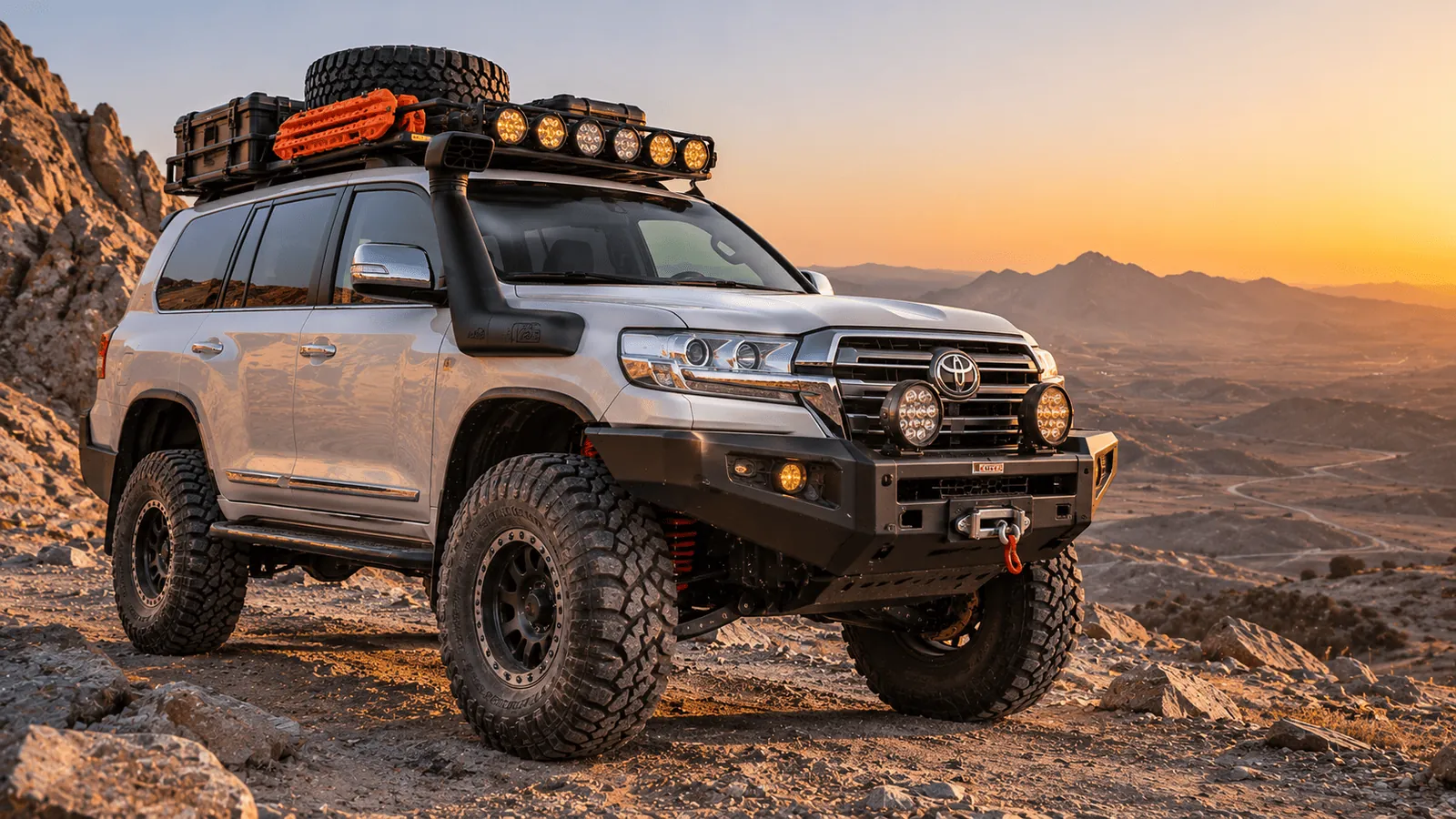
A Toyota Land Cruiser can leave the showroom with serious desert capability, but a good UAE build is not created by fitting the largest tyres and tallest lift available. The vehicle still needs to commute comfortably, brake predictably, manage heat, pass inspection and carry passengers or camping equipment without exceeding its limits.
The best modified Land Cruiser is built around its real job. A lightweight weekend dune vehicle requires a different setup from an LC300 prepared for family overlanding or an older LC200 used on rocky wadi routes. Every extra component changes weight, suspension behaviour, cooling and service needs.
This guide explains how to plan a balanced build, which upgrades should come first and what UAE owners must verify before making permanent changes.
Decide What Kind of Land Cruiser You Are Building
Start by defining the vehicle’s main use:
- Daily driving with occasional desert trips
- Frequent dune driving
- Family camping and overlanding
- Rocky tracks and wadi crossings
- Long-distance touring
- Towing or carrying permanent equipment
- Off-road-only or competition use
A dune-focused Land Cruiser benefits from controlled weight, suitable tyres and dependable cooling. An overlanding build needs payload planning, storage, auxiliary power and long-term serviceability. A rock-oriented vehicle may need more underbody protection and carefully managed clearance.
Do not buy Off-road accessories Dubai simply because they appear on other builds. Each addition should solve a specific problem and suit the exact Land Cruiser generation, trim and factory equipment.
Identify the Exact Land Cruiser Before Ordering Parts
“Fits Land Cruiser” is not enough. The LC300, LC200, LC100 and 70 Series use different chassis, suspension designs, engines and electronic systems. Even within one generation, model year and trim can affect compatibility.
Before buying parts, record:
- The VIN and chassis code
- Production month and model year
- Engine and transmission
- Trim and wheelbase
- Current tyre and wheel sizes
- Factory suspension systems
- Front and rear axle weights where possible
- Existing accessories and permanent loads
Some UAE LC300 variants include technologies such as Adaptive Variable Suspension, Multi-Terrain Select, Crawl Control, a multi-terrain monitor and other integrated safety systems. Not every trim has the same equipment. A suspension or bumper supplier must therefore confirm compatibility with the exact vehicle rather than assuming every LC300 is identical.
Check UAE Approval Requirements Before the Build
UAE Federal Decree-Law No. 14 of 2024 states that substantial modifications to a vehicle’s shape, chassis, body, engine power or colour require licensing-authority approval. A vehicle covered by those provisions cannot be used until it has been inspected and the modifications approved.
In Dubai, RTA performs vehicle technical inspections, and vehicles with modified bodies or special characteristics may be referred to the Technical Inspection Committee.
This means owners should not rely on statements such as “every two-inch lift is legal” or “this part passed on another car.” Requirements can depend on the vehicle, modification, supporting documents and inspection outcome.
Before ordering irreversible or substantial modifications:
- 1Prepare a written list of proposed components and specifications.
- 2Confirm the applicable approval route with RTA or the relevant licensing authority.
- 3Use traceable products with installation instructions and technical documentation.
- 4Keep invoices, certificates and workshop records.
- 5Notify the insurer and obtain written confirmation regarding coverage.
- 6Check the effect on manufacturer or extended warranty.
A product being available in the UAE does not automatically make every installation approved for public-road use.
Phase 1: Inspect and Service the Vehicle
Do not modify maintenance problems. Before planning Off-road builds Dubai, check:
- Engine and transmission cooling systems
- Fluid condition and leaks
- Steering, bushes and wheel bearings
- Dampers, springs and mounting points
- Brake condition and brake fluid
- Battery and charging system
- Tyre age, damage and load rating
- Four-wheel-drive and differential systems
- Diagnostic faults and dashboard warnings
A worn bush can make a new suspension kit feel unstable. A partially restricted radiator may only reveal itself once the vehicle is heavily loaded in soft sand. Bigger tyres can expose weak brakes or steering components.
Record baseline ride height, alignment, temperatures and axle weights. This gives the workshop evidence for selecting components and a reference for checking the finished build.
Phase 2: Choose Tyres for UAE Desert Use
Tyres have a greater effect on desert performance than many visual modifications. The correct choice depends on how much highway driving the Land Cruiser still does and whether the vehicle also encounters rock.
Highway-Terrain Tyres
These are usually quieter and lighter, with predictable road manners. They may suit a mostly standard daily driver that makes occasional easy desert trips, provided their construction and condition are appropriate.
All-Terrain Tyres
All-terrain tyres provide a useful compromise for mixed highway, desert and wadi use. However, designs vary significantly in weight, sidewall construction and tread pattern. A heavy aggressive tyre can reduce acceleration and increase unsprung mass.
Mud-Terrain Tyres
Mud-terrain tyres are not automatically the best choice for sand. Their aggressive tread, noise and weight may offer little advantage to a UAE driver who rarely encounters mud. Choose them only when the actual terrain justifies the compromise.
Select a tyre with suitable load and speed ratings. Confirm clearance at full steering lock and throughout suspension travel. Increasing diameter affects effective gearing, speedometer accuracy, braking and stress on the driveline.
Airing Down Without Damaging the Tyre
Lower tyre pressure increases the footprint on sand, but there is no single correct pressure for every Land Cruiser. Vehicle weight, tyre construction, wheel width, temperature, speed and dune conditions all matter.
Reduce pressure gradually, compare tyre shape and traction, and avoid high-speed turns that can unseat a bead. Carry an accurate gauge, deflator and compressor. Restore suitable road pressure before returning to the highway.
Extremely low pressure increases the risk of bead separation and sidewall damage. Driver technique should improve before pressure is reduced further.
Phase 3: Select the Right Wheels
Wheel diameter, width, offset, load rating and brake clearance must work with the tyre and vehicle. Excessively negative offset can increase leverage on wheel bearings, change steering behaviour and throw sand or debris beyond the body.
Avoid choosing wheels only from appearance. Ask for:
- Verified load rating
- Correct centre bore and mounting specification
- Brake-caliper clearance
- Suitable width for the selected tyre
- Manufacturer road-use documentation
- Replacement availability in the UAE
Beadlock Wheels UAE Owners Should Understand
True Beadlock wheels UAE drivers use mechanically clamp one tyre bead to the rim. They can help at very low off-road pressure, but they add hardware, maintenance and inspection considerations.
Some wheels only imitate the beadlock appearance, while some functional beadlocks are labelled for off-road or competition use. Do not assume either type is automatically accepted for public roads. Confirm the product’s certification and load rating, then check the exact installation with the licensing authority before purchase.
Most recreational desert drivers do not need functional beadlocks. Suitable conventional wheels, correctly matched tyres and responsible pressure management are often the simpler solution.
Phase 4: Build the Suspension Around Finished Weight
A Land Cruiser suspension lift Dubai should be selected after the expected permanent load is known. Springs support weight; dampers control movement. Lift height alone does not identify the correct system.
Permanent front load may include:
- Steel or aluminium bumper
- Winch
- Bash plates
- Auxiliary battery
- Driving lights and brackets
Rear load may include:
- Drawers
- Fridge and slide
- Water storage
- Auxiliary power system
- Spare wheel carrier
- Roof equipment and regular camping gear
Heavy-load springs can ride harshly when the vehicle is empty. Light springs may sag and reduce travel once accessories are fitted. A well-planned Suspension upgrade Dubai matches spring rate and shock valving to the real axle load and intended terrain.
Depending on the vehicle and lift, the complete plan may also require geometry correction, upper control arms, panhard adjustment, bump-stop changes, sway-bar assessment, brake-line checks and recalibration of affected systems.
For LC300 models equipped with adaptive or electronically integrated suspension, use products specifically confirmed for that equipment. Do not remove or bypass factory systems without understanding the safety, diagnostic and inspection consequences.
After Lift kit installation Dubai, complete an alignment, check every hose and wire through suspension travel, road-test the vehicle and follow the kit maker’s re-torque procedure.
Phase 5: Protect the Underbody Without Adding Excess Weight
Useful protection can cover the sump, transmission, transfer case, fuel tank and other exposed components. Steel generally handles repeated concentrated rock impacts well, while aluminium can save weight for sand-focused and touring vehicles.
Design matters more than material alone. Vehicle-specific plates should mount to suitable structural points, preserve cooling and drainage, protect their fasteners and allow reasonable service access.
Do not cover the entire underside simply because plates are available. Every panel adds weight, and packed sand can accumulate above poorly designed protection. Build for the terrain the vehicle will actually encounter.
Phase 6: Add Rated Recovery Equipment
Essential 4x4 accessories UAE desert drivers should consider include:
- Accurate tyre-pressure gauge
- Tyre deflator and suitable compressor
- Long-handled shovel
- Recovery boards for sand
- Gloves and first-aid kit
- Rated kinetic rope or suitable recovery strap
- Rated soft or bow shackles
- Communication equipment
- Water and basic emergency supplies
Recovery points must be properly engineered and installed. A factory transport tie-down or tow ball should not be assumed safe for dynamic recovery. Match every component’s rating and inspect ropes, shackles and points for damage.
Travel with another suitable vehicle when possible and learn recovery technique from experienced operators. Equipment cannot compensate for poor communication or unsafe positioning.
Phase 7: Choose Bumpers and a Winch Carefully
A bumper can improve protection and provide mounting for recovery equipment, but it may add substantial front-axle weight. It can also affect cooling airflow, crash systems, cameras, parking sensors and lighting.
Before fitting one, confirm:
- Vehicle-specific mounting and load path
- Compatibility with airbags and safety systems
- Clearance for cameras and sensors
- Access to recovery points
- Cooling airflow
- Number-plate visibility and legal mounting
- Total added weight over the front axle
- RTA or licensing-authority requirements
A winch needs suitable capacity, secure structural mounting, electrical protection and accessible isolation. Synthetic rope saves weight but still requires inspection and protection from heat and abrasion.
Phase 8: Plan Cooling for Soft Sand and UAE Heat
Soft sand creates sustained engine load at relatively low vehicle speed, reducing natural airflow. Larger tyres, additional weight and blocked grille areas can add to the challenge.
Begin with maintenance:
- Clean and inspect the radiator and condenser
- Check coolant condition and correct specification
- Verify fans, shrouds, belts and hoses
- Inspect transmission and engine-oil cooling systems
- Use live temperature data where appropriate
- Keep grille airflow clear of poorly placed accessories
Do not replace the radiator simply because the vehicle has been modified. Diagnose whether temperatures are caused by maintenance, airflow, driving technique, gearing or actual cooling capacity. Any auxiliary cooler must be correctly sized, mounted and plumbed.
Phase 9: Add Lighting Without Creating New Problems
An off-road light bar or driving lamps should be chosen by beam pattern, measured output, thermal design, ingress protection and electrical demand—not advertised lumens alone.
The installation should include correctly sized cable, a near-source fuse, suitable relay or controller, weather-resistant connections and secure grounding. Keep wiring away from exhaust heat, sharp edges and moving parts.
Lights must not obstruct factory lamps, sensors, cameras, the number plate or cooling airflow. Many auxiliary products are designated for off-road use only, so confirm their permitted installation and use before driving on public roads.
Phase 10: Plan Roof Loads and Storage
Roof racks, awnings and rooftop tents can make touring easier, but they raise the centre of gravity and affect handling. The rack, tent, awning and cargo must remain within both the vehicle and rack manufacturers’ limits.
Dynamic capacity while driving can be much lower than the static parked figure. Heavy items should be stored low and securely inside the vehicle where practical.
Drawer systems must be attached to suitable mounting points and should not prevent access to the spare wheel or emergency equipment. Calculate the combined weight of drawers, fridge, battery, water, tools and recovery gear rather than considering each item separately.
Phase 11: Design the Auxiliary Electrical System
Fridges, camp lights, radios, compressors, cameras and inverters can justify an auxiliary battery, but capacity should be calculated from actual watt-hours.
A complete system may include:
- Approved battery and secure mounting
- Compatible DC–DC charger
- Solar input where useful
- Cable sized for current and distance
- Fuses close to each power source
- Protected distribution and labelled circuits
- Battery monitoring
- Suitable ventilation and heat management
Do not mount a lithium battery under the bonnet unless its manufacturer specifically approves that location. UAE heat can exceed the battery’s operating or storage limits.
LC300, LC200 and 70 Series Need Different Plans
LC300
The LC300 combines off-road systems with extensive electronics and, on selected variants, adaptive suspension and driver-assistance technology. Modifications must preserve sensor operation, cooling, calibration and diagnostic compatibility.
LC200
The LC200 remains a popular base for a Custom 4x4 build Dubai, but age and condition now vary widely. Inspect cooling, hydraulic or suspension systems, bushes and wheel bearings before upgrading. Existing modifications should be identified rather than assumed to be factory equipment.
70 Series
The 70 Series can suit touring and demanding work, but payload distribution, rear suspension, tyre choice and braking still require a complete plan. Its traditional appearance does not mean every modification is simple or exempt from approval.
The parts list should follow the exact vehicle, not merely the Land Cruiser badge.
A Sensible UAE Land Cruiser Build Sequence
Use this order for most recreational builds:
- 1Inspection and overdue maintenance
- 2Driver training and essential recovery equipment
- 3Suitable tyres, pressure tools and verified wheels
- 4Protection and recovery points required by the terrain
- 5Permanent accessory and axle-weight calculation
- 6Weight-matched suspension and alignment
- 7Cooling, lighting and electrical systems
- 8Storage, roof equipment and touring accessories
- 9Final inspection, legal documentation and insurer confirmation
- 10Local testing before remote travel
This approach prevents suspension being selected before the final vehicle weight is known.
How Car Space Plans Land Cruiser Builds
Car Space develops bespoke plans based on budget, driving style and UAE conditions. Its off-road services cover suspension, tyres, bumpers, lighting, roof racks and complete builds for Land Cruiser, Patrol, Prado and Jeep owners.
For a Land Cruiser, the consultation should connect every modification:
- Tyre size with gearing, clearance and braking
- Bumper and winch weight with spring selection
- Roof and storage systems with payload
- Lighting and refrigeration with electrical capacity
- Protection with cooling and service access
- Lift and wheels with inspection requirements
Car Space can also help customers source compatible Off-road accessories Dubai builds need and organise the project in phases. The goal is a vehicle that remains predictable on the road and becomes more capable of it not a collection of unrelated parts.
The same consultation method changes with the platform. A Nissan Patrol off-road build Dubai may need different suspension and cooling decisions, while a Prado off-road upgrade Dubai often places greater emphasis on daily comfort and weight control. Those comparisons are useful, but Land Cruiser components should always be chosen for the exact Land Cruiser rather than copied from another 4x4.
Build for the Desert, but Keep the Land Cruiser Balanced
A successful Land Cruiser build does not need to be extreme. Reliable tyres, pressure control, recovery readiness and driver skill often produce a bigger improvement than unnecessary height or heavy exterior accessories.
Inspect first. Confirm approvals before permanent work. Weigh the vehicle, protect its cooling and safety systems, and select suspension around the finished load. Test locally and adjust using evidence.
That is how a Toyota Land Cruiser modified for off-road use becomes dependable in UAE deserts rather than simply different from standard.________________________________________________________________
Frequently Asked Questions
What modifications should I make first for UAE desert driving?
Does a Land Cruiser need a suspension lift for dune driving?
What is the best suspension setup for an LC300 in Dubai?
Are off-road modifications legal in Dubai?
Where can I plan a Land Cruiser off-road build in Dubai?
Need Help?
Talk to a Car Space Expert
Get personalised advice on buying, selling, inspecting or building your car in the UAE.
Book a Free ConsultationCar Space Services
More Articles
Why Your 4x4 Overheats While Off-Roading and the Cooling Upgrades That Fix It
6 min read · Off-Road
The Tyre Pressure Mistake That Gets You Stuck Dune Bashing in Dubai
6 min read · Off-Road
What Recovery Gear to Carry to Avoid Getting Stuck in the UAE Desert
7 min read · Off-Road
Why Your Snorkel Isn’t Protecting Your Engine the Way You Think
8 min read · Off-Road