
Why Amber Beats White Off-Road Lights in Desert Dust
Compare amber vs white LED offroad lights for UAE desert driving. Learn how amber reduces glare in dust and when white light performs better.
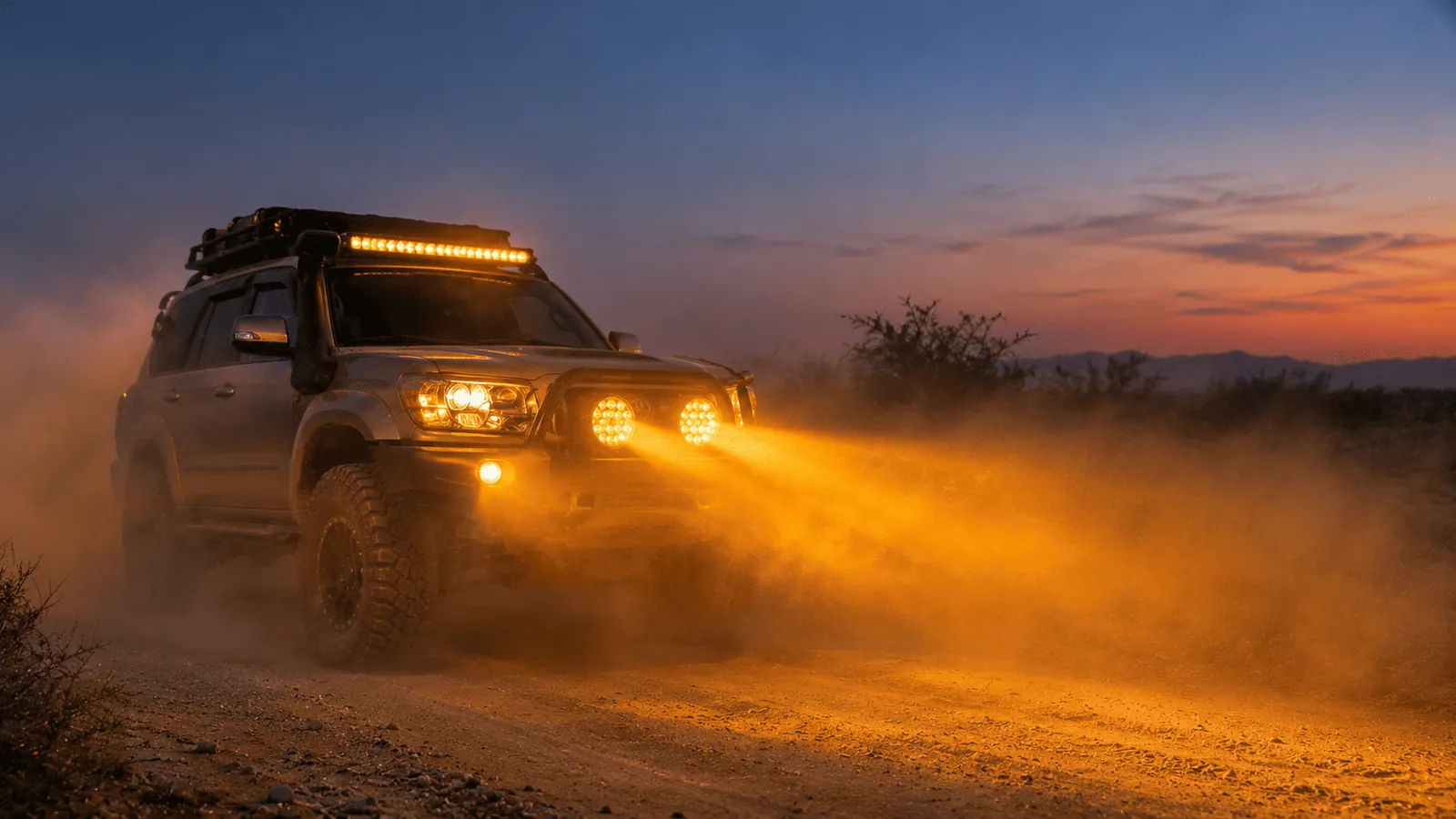
Switching on a powerful white light bar in clean night air can make the desert look almost like daylight. Drive into another vehicle’s dust cloud, however, and that same output can create a bright wall in front of the windscreen. More light does not always mean more usable vision.
That is where the debate around amber vs white off road lights becomes practical. Amber light can reduce the glare reflected from suspended dust and help the driver read contrast and terrain with less visual fatigue. White light usually provides greater peak intensity, longer reach and more natural colour recognition when the air is clear.
The right choice depends on conditions, beam pattern, mounting position and speed, not simply which colour appears brighter in a showroom.
Why White Light Can Become a Problem in Dust
Dust particles scatter and reflect light back towards the driver. Cool-white LEDs contain a stronger blue component, and shorter wavelengths are more prone to scattering through the atmosphere and airborne particles.
When a high-output white beam illuminates dense dust close to the vehicle, the reflected light can overpower the darker terrain beyond it. Your pupils react to the bright foreground, making distant details harder to see. The result is similar to using high beams in fog.
This does not make white lighting poor technology. It means its output and beam need to suit the conditions. In clear desert air, a quality white driving or spot beam can provide excellent distance and detail.
Why Amber Lights Work Better in Dust
Amber filters out more of the blue and green portion of white LED output, producing warmer light. This can reduce perceived backscatter and glare in dust, fog or rain. Drivers may find it easier to distinguish dune edges, ruts and changes in surface texture.
Quality amber lights for dust are therefore less about making the scene brighter and more about making the available light easier to use. The warmer tone can also feel less tiring when the driver is following another 4x4 or travelling through a dusty convoy.
There is a trade-off: a darker amber lens normally reduces peak intensity compared with a clear lens on the same lamp. Amber is not a magic beam that passes through every dust cloud. It improves the quality of vision in adverse conditions, while white often wins for outright distance in clear conditions.
Amber vs White LED Offroad Lights: Quick Comparison
| Driving condition | Amber lighting | White lighting |
|---|---|---|
| Dense dust or haze | Lower perceived glare and improved contrast | Can create strong backscatter |
| Clear open desert | Useful but usually less peak intensity | Better range and maximum detail |
| Slow technical terrain | Comfortable wide foreground light | Strong detail if aimed correctly |
| High-speed open tracks | Helpful as a supporting wide beam | Better suited to long-range illumination |
| Convoy driving | Useful front lighting and rear dust visibility | Can reflect heavily from the vehicle ahead’s dust |
| Colour recognition | Warmer, less natural colour rendering | More natural terrain and object colour |
In the amber vs white LED offroad lights comparison, neither colour replaces correct beam placement or responsible speed. Amber cannot compensate for driving too fast for visibility, and white cannot reveal terrain hidden inside a dense dust cloud.
Beam Pattern Matters as Much as Colour
A badly aimed amber spot can still create glare, while a carefully positioned white beam may remain useful. Beam pattern controls where the light goes:
- Spot or long-range beam: narrow and designed to see farther ahead.
- Driving beam: balances distance with moderate width.
- Wide or cornering beam: spreads light across the near field and sides.
- Flood or work beam: provides broad close-range illumination at low speed.
For dusty desert driving, a low-mounted amber wide or driving beam can illuminate the track without flooding the air directly in front of the driver’s eyes. White spot or driving lights can then be kept available for clear sections where longer range is valuable.
The best off-road lights for desert use are chosen as a system. One enormous bar is often less effective than separate lights with different jobs.
Mounting Height Changes Backscatter
Roof-mounted lighting looks impressive and can provide reach in clean air. In dust, however, light positioned close to the driver’s eye line may reflect directly back towards the windscreen. Roof lights can also illuminate the bonnet and create distracting glare.
Lower bumper or grille-mounted lamps can reduce some of that reflection, especially when they use a controlled wide beam. Their brackets must remain rigid, and the lights should not block airflow, sensors or recovery access.
Rear dust or chase lights have a different purpose. They help the following vehicle see you when your 4x4 is creating a dust cloud. These lamps are often mounted high so they remain visible above the densest dust. They should not be confused with reverse lights, and their intensity and use must be appropriate for the group and conditions.
When White Off-Road Lights Are the Better Choice
White remains valuable when:
- The air is clear and maximum distance is required
- You are travelling across open terrain at an appropriate speed
- Accurate colour recognition matters
- You need to identify rocks, markers or obstacles farther ahead
- The lamp has a controlled beam and is correctly aimed
White light often appears brighter because it delivers higher peak intensity through a clear lens. It can also make natural colours easier to recognise. Replacing every white lamp with amber may therefore reduce the range and detail available on clear nights.
This is why many well-designed 4x4 lighting packages use amber for near-field or adverse-weather visibility and white for distance.
When Amber Lighting Provides the Greatest Benefit
Amber is particularly useful for:
- Following another 4x4 through suspended dust
- Convoy drives with reduced visibility
- Dusty, hazy, rainy or foggy conditions
- Low-speed dune or trail navigation
- Reducing harsh foreground glare
- Rear dust or chase-light visibility
Drivers with sensitive eyes may also prefer warmer light during long night trips. However, preference should not replace testing. Aim the lights on a controlled off-road route and compare how well you can identify terrain at realistic speeds.
Selective Amber LEDs vs Amber Lens Covers
Amber output can be produced by dedicated amber LEDs, an amber lens or a removable cover over a white lamp. These approaches can differ in colour, efficiency, output and serviceability.
A removable cover gives the owner flexibility: clear lighting for open terrain and amber for dust. It must be made for the specific lamp, fit securely and tolerate heat. An unapproved film or dark tint can distort the beam, trap heat or reduce output unpredictably.
Some premium lights use replaceable lenses, allowing the colour or pattern to change while retaining the housing and wiring. Follow the manufacturer’s approved combinations because optics are designed around particular LEDs and lens surfaces.
Do Not Choose by Lumens Alone
Raw lumens describe theoretical light output, not how effectively a lamp illuminates the terrain. More useful data includes lux at a stated distance, beam angle, current draw, thermal behaviour and a real beam-pattern image.
For amber lights for dust, a controlled beam with lower headline lumens may provide better visibility than a scattered high-output bar. The goal is to reduce the bright foreground curtain, not to illuminate every particle in front of the vehicle.
Also check the housing, thermal management, ingress rating, vibration testing, EMC protection, connector quality and warranty. Colour cannot rescue a poorly engineered lamp.
A Practical UAE Desert Lighting Setup
For a daily-driven 4x4 that regularly visits the desert, a balanced setup may include:
- 1Road-approved factory lighting for public-road use
- 2Low-mounted amber wide or driving lights for dusty terrain
- 3White long-range lights for clear off-road sections
- 4High-mounted amber rear dust lights for organised convoys
- 5Independent, labelled switches for each lighting zone
- 6Correctly rated fuses, relays, cable and waterproof connectors
Each circuit should be professionally installed and aimed. Many auxiliary products are marked for off-road use only; confirm UAE requirements and never use them on public roads in a way that dazzles other drivers.
How to Choose Off-Road Lights With Car Space
Car Space helps owners select lighting by beam purpose, terrain, mounting position and vehicle electrical capacity. When comparing Off-road accessories Dubai drivers should ask for measured beam data, product ratings, wiring specifications and warranty support—not only a night photo taken with exaggerated camera settings.
Lighting should also integrate with the wider build. The right 4x4 accessories UAE package considers brackets, roof racks, bumpers, switches, batteries and alternator capacity together.
Amber beats white when dust reflection is the problem. White beats amber when clear-air distance and colour detail are the priority. The strongest setup gives the driver the right light for each condition and the discipline to slow down when visibility disappears._____________________________________________________________________
Frequently Asked Questions
Are amber or white off-road lights better in desert dust?
Why do amber lights reduce glare in dust?
Are amber lights less bright than white lights?
What are the best off-road lights for desert driving?
Where can I buy amber and white off-road lights in Dubai?
Need Help?
Talk to a Car Space Expert
Get personalised advice on buying, selling, inspecting or building your car in the UAE.
Book a Free ConsultationCar Space Services
More Articles
Why Your 4x4 Overheats While Off-Roading and the Cooling Upgrades That Fix It
6 min read · Off-Road
The Tyre Pressure Mistake That Gets You Stuck Dune Bashing in Dubai
6 min read · Off-Road
What Recovery Gear to Carry to Avoid Getting Stuck in the UAE Desert
7 min read · Off-Road
Why Your Snorkel Isn’t Protecting Your Engine the Way You Think
8 min read · Off-Road